Monday, March 15, 2010

Circularity.

Og hér ert þú, Glósóli.  And now you’re here, Glowing soulThere is this thing at the core and a light tearing at my insides—and this is that which I call mine.  Above all things, know thyself.  Know thyself.  Life is a constant climb and struggle to hold the word “I”, while only even just beginning to wrap fingers around what all that means.  The artist is he who understands this clawing within him and embraces the process of releasing, remembering, and retaining all that he is.  Circulation of work must begin with the self, with the constant shifting, ever-growing body of thoughts and ideas suspended in the vessel.


To jump immediately into the public’s eye is suicide, as man is but a beginner in everything.  An amateur.  A fledgling.  He must first gather his wits about him and venture into that which makes him; he himself must discover the truths housed within the beautifully synchronized entanglement of chemicals and matter.  This sphere into which he enters in order to pursue requires much, asks more.  Solitude asks the very questions one can neither form nor answer.  But the artist ought to have no fear.
“I want to beg you, as much as I can, dear sir, to be patient towards all that is unsolved in your heart and to try to love the questions themselves like locked rooms and like books that are written in a very foreign tongue. Do not now seek the answers, which cannot be given you because you would not be able to live them. And the point is to live everything. Live the questions now. Perhaps you will then gradually, without noticing it, live along some distant day into the answer.”
Everything changes in every single way it can, and that holds especially true to one’s perception of the core.  It is the self that remains untouched and consciousness that grows in fullness.  Gradually, eyes are open to that surging thing within and man might begin to suspect his strength— to know the power of his voice, the invincibility of his memory, and the beauty of his ideas.  Once some time has been spent in introspection, as he continues to blossom and ripen in understanding, the creator may take steps in direction of the world.
The world, though, does not want him to succeed.  It seeks to destroy him, for the man who stands alone—the artist, the thinking individual—does not belong in the world as it is but is a being from the world as it should be.  The trappings of reality, however, hold him to this earth and so he embarks on the constant battle to remain himself.  The interconnectivity of everything demands that he live and react with all else, and the clawing thing at his center begs him to display that which resides within.  He never is to give away any piece of himself nor tell his secret of being; he is only to show—to participate in the flow of life and not be consumed by the masses.  His branches stretch out to mankind, just as his roots extend in self-knowledge.  He offers that much more of humanity—and, in turn, comes to know its nature more clearly—in the act.  Art, anything to be called a creation not excepting the self, spreads humanity.
The ease of the travel, however, depends entirely on the notion of relational aesthetics, and this foundation rests on the principle that the audience is not an audience.  All are human beings.  Painstakingly, with each exchange of words and ideas—with each human relationship, the perfect form of humanity and the motion of the world come close to being understood.  The artists cannot compromise their work—or their core—for the sake of others.  They must present everything as it is, as they see it, and not as they think society perceives.  Truth, then, is never abandoned.  And the voice of humanity carries on.
But, with this invitation to “come and see”, criticism is welcomed.  And, in this, the artist must be resilient.  He should not edify walls around his supposed monument of beliefs, though; rather, his mind should serve as a filter and find the things that agree with the core and the thoughts that challenge him to seek still more and become that much more himself.  He must persist, accepting the constancy of change by allowing the words of others to enter his space.  His hands are the tools of change, his mind and core their master.  The beauty of ideas, so long as they are never abandoned, lies in their capacity to be shaped and grow into themselves.  They are as a cool block of marble, each thought-provoked chisel mark creating the eventual sculpture, which was always to be made.  Time.  It takes time.
The sculpture—the emerging ideas—is a product of connection and the precursor to networking.  Mankind is a vast sea of intertwining webs spanning continents and oceans.  Once this resource starts to be tapped into, the power of a single thought and its author is amplified. Individual people, as drops in the great bucket, may resound.  Collisions are not to be sought unless they spark some larger mechanism for conceptualizing humanity.  True, too much of a good thing is bad, but just enough of the terrible is desired.  Negativity leads to thirst, and failure to hunger.  Growth.

There ought to always be motion, though, with forward velocity.  Others should be sought and collected as precious treasure, for it is the brothers who help to uncover the hidden rooms within the vaults of the mind.  They help the artist to awaken the sleeping notyetformed ideas and give still another wealth:  memory.  Experience and exchanges excite newness and resonate with already existent thoughts.  From interactions with the rest of mankind, the artist is able to speak more clearly and more fully comprehend the words.  He might come to address humanity.

Tuesday, March 2, 2010

For now, contradiction.

When understanding creativity becomes a science, all contradictions vanish and new ones arise.  To place something so free-moving as art is to impose the rules of black and white to the world as we know it.  It seems quite so, however, that this was entirely the aim of the article.

Within every mind there dwells a vault of notyetgiven ideas and notyetformed thoughts--a mix of disagreement and simultaneous harmony, having all sprung from one core.  The world is indeed black and white but not in an either/or fashion but, rather, this and that all at once.   Reality stands as a constant movie reel of contradictions and mankind finds itself always correct some anticipated unbalance solely because of the belief in opposites.  Since A is A, everything that is not A is an opposite and a contradiction within that frame.  A and not A cannot exist in harmony; there is constant tension for resolve.  In the Janusian process everything remains unresolved.  Beautifully moot and melodious.

Juxtaposed, science and art seem to contradict one another in any mention of their connectivity.  Scientists are creators.

Tuesday, February 16, 2010

All conflict and understanding.

The impossibility of finding balance within myself—an equilibrium of soul and thought within my very core—caused the word no to spring to the tip of my tongue as I followed the article down the length of its pages.  I find the idea of collectivism detestable and brotherhood deplorable, though I can rationalize their existence.  Society demands and requires groups to make sense of all that remains to be understood, especially in that which we call art.

Relational aesthetics calls the whole of mankind to come and see, to know there is a common thread running through humanity and tying the strings of Is.  In this way, the artist does not abandon that which should be held above all else:  the self.  A conglomerate of selves, in form of the word collective unit, group, allows outsiders to the work to see different parts of humanity and of the reality called the world revealed in the pieces pulled from each individual artist.  It is the self-formed mirror of the subconscious that permits the relation of one human being to another through two- or three-dimensional space.  The artwork has the tremendous capacity to reflect the human experience because its creation was all experience; its essence laid bare in the act.  Humanity can be seen in art so long as the painters, the sculptors, the photographs--even the amateurs--poured from the core in a simultaneous conscious and unconscious act of making.

Multiple authors, one piece.  Each being is a shadow of the form of humanity and enabling the shadows to be collected in one place, such as an artist group, gives a clearer sense of the form.  Collectivism, in this case, does not eliminate the man alone--the individual--but, rather, reveals a sea of souls within the oneness of a piece of art.  The unit is a temple and a transmogrifier, housing the separate selves in their untouched state and reshaping the individual cores into the mold of a unified whole.

Everything in its place.

See the world; know its people.  To see, to know that much more of humanity is a tremendous calling to which I will be forever climbing.  I wish to step behind the eyes of another people—another world—and, in that, find so much more distinctly the chord that plays through all mankind.  It is the thread intertwined with humanity itself, which proves there is something within the core of every being that is one and the same.  It is not the peoples who are different; rather, it is the face, the colors, the places, and experiences shaping the person’s form and life’s journey.  I wish to collect as many pieces of the world as I can so that I might form some semblance of pure humanity.  There are many things to which I aspire but, at the heart of it all, is a common theme:  I wish to give in the way only one human being can to another. To those suffering from diseases, needing the healing touch of another human being’s hand, I want to give.  To those without a voice, I wish to give words and form to their stories. It makes complete sense to me—and could not be otherwise—that I wish to pursue a degree in both an art and science and a minor in human studies.  People fascinate me and will never cease to intrigue.  I wish to capture, understand, renew, and enrich their lives in film, study, medicine and art.  Everything finds its place.

Ghana presents so many possibilities that once seemed unreachable. 

Friday, February 5, 2010

Finally.

Tuesday, February 2, 2010

New Weather


Today saw all greys and the vibrance of colour. It held the sort of rain that could not be anything but good and lovely and right. I walked to the Contemporary Art Museum under dripping leaves and across small puddles.

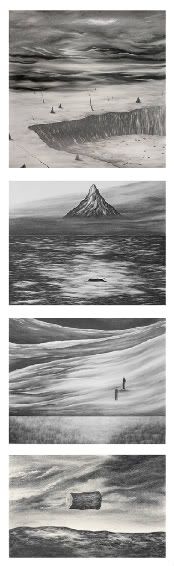
Finding New Weather within the walls, I ran the course of the wood-paneled floors, the white drywall. Three artists' work filled and yet were captured within doorless rooms. In the first, the charcoals of Robyn O'Neil were placed upon the verticals. An imposing form stood in center. Forever (Blank) Matter, it was entitled. It appeared as an intricate megalopolis perched upon and around and within a steep mountain of steel. The metal cage giving shape to matter was covered in the white buildings of nearlyevery architectural style.

That which we behold is but matter, substance—objects with mass occupying space. As artists and individuals, it is our calling and natural desire to give shape to organic matter, to resurrect forms the world should know.

The charcoal pieces were equally enthralling. Etchings and lines creating some idea of waves or wind or some other element were found throughout O'Neil's body of work. Even the sense of infinity and void could be had. They were otherworldly, haunting, and beautifully primitive. The drawings embodied atmospheres and other spheres and yet each spoke volumes of the ideas—harmony, pressure.

Through a more narrow hallway, smaller versions of the aforementioned greys lining the length, the space opened into still more. Another structure of Al-Hadid's stood, appearing to be suspended only by the empty space beneath it: The Edge of Destiny. Remaining blank space, the fantastical layers of montage collage hung.

Existence.

The world in which the reality is eyes and words and questions cannot accept simply that something exists. There must be proof of its being or having been and a reason for its being. An attempt to capture the essence of these somethings has led to the process of documentation, cataloguing, storing in archives. Art is an act—of love, of creating—and the creation itself, and it is this object the world beholds as almost theirs. The artist may live apart from mankind as a whole but in the desire to speak humanity, the body of their work ought to pass through the hands of society. In this way a oneness seeks to be found, a perfect oscillating pattern pulsing through people begs to be reached.

This experience cannot be had be it not for the evidence discovered in images of the art itself. These reproductions, always less than the things in themselves, ought to approach the near perfect form of the art. The ideas surging beneath, from which the work sprung, should be captured; the core of the artist should be plainly spattered and bared upon photopaper. Taking photographs of the pieces should fall upon the individual for it is they who speak need; they know which images reach the infinity of best. Precise mirror representations of artwork do not scream the truth of its existence. Always more than meets the eye; the creator knows.

Promotion, a primary purpose for the production of duplicates in images, falls greatly before that which the artist begs the eyes of man to see. One and one alone can determine existence.